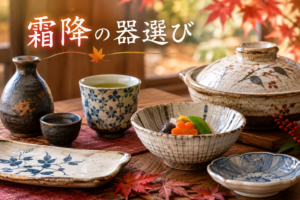
今年の霜降は、十月二十三日ごろ。
秋が深まり、朝の空気に冬の気配がまじりはじめる頃です。
草の上の露が冷えて、霜に変わっていく。
そんな季節の名前です。
三島の朝も、ずいぶん冷えるようになりました。
晴れた日には、富士山の頂がうっすらと白く見えます。
三嶋大社の境内でも、木々の葉が少しずつ色づいてきました。
この時期、食卓にも変化が訪れます。
冷たい麺より、湯気の立つ汁もの。
ガラスの器より、手に持って温かい器。
体が自然と、ぬくもりを求めはじめます。
そこでおすすめしたいのが、土ものの器です。
陶器は厚みがあり、熱がゆっくり伝わります。
熱いお茶を注いでも、手にやさしい。
そして、冷めにくい。
寒い季節にこそ、その良さが感じられます。
たとえば、少し大ぶりの湯呑み。
朝の一杯を、両手で包むように持ってみてください。
指先から、じんわりと温かさが伝わってきます。
新米の季節には、お気に入りの飯碗を。
きのこや根菜の煮物には、深めの小鉢がよく似合います。
蓋付きの器なら、料理の温かさを食卓まで運べます。
色で選ぶのも、この季節の楽しみです。
熟した柿を思わせる、柿釉の赤茶色。
落ち葉のような、飴釉の深い色。
そして白い粉引の器は、霜の降りた朝の景色によく似ています。
器を少し替えるだけで、食卓に季節がやってきます。
冬支度は、器からはじめてみるのもいいかもしれません。
杉浦陶器店では、秋から冬に活躍する器を取りそろえています。
三嶋大社にお参りの際は、どうぞお気軽にお立ち寄りください。
次回は、冬のはじまり「立冬」をお届けします。
Choosing Tableware for Sōkō
Around October 23rd, Japan’s calendar marks Sōkō (Frost Descent).
It is one of the twenty-four seasonal divisions of the traditional year, each lasting about two weeks.
The name describes a quiet change in nature.
Morning dew grows colder, and slowly turns to frost.
Autumn is deepening, and winter is just around the corner.
Here in Mishima, the mornings have become crisp and cool.
On clear days, the summit of Mount Fuji shows a thin layer of white.
At Mishima Taisha (a historic Shinto shrine just steps from our shop), the trees are beginning to turn red and gold.
As the air cools, the Japanese table changes too.
Cold noodles give way to steaming soups.
Glassware is put away, and heavier, warmer pieces come out.
We begin to crave things we can hold in our hands.
This is the season for stoneware.
Compared to porcelain, stoneware is thicker and more earthy.
Heat passes through it slowly.
Pour in hot tea, and the cup stays gentle in your hands.
And it keeps your drink warm for longer.
Try a slightly larger yunomi (a Japanese teacup without a handle).
In the morning, hold it with both hands.
You’ll feel the warmth spread gently through your fingers.
Autumn is also the season of shinmai (the year’s newly harvested rice).
In Japan, it is a small celebration served in a favorite rice bowl.
Simmered mushrooms and root vegetables look lovely in a deep, small bowl.
And a lidded dish carries the warmth of the food all the way to the table.
Color is part of the pleasure, too.
Kaki-yū, a persimmon glaze, has a deep reddish-brown tone, like ripe autumn fruit.
Ame-yū, an amber glaze, recalls the color of fallen leaves.
And kohiki, a soft white slip, looks just like a frosty morning.
Changing a single dish can bring the season to your table.
In Japan, people prepare for winter in many small ways.
Why not begin with the tableware you use every day?
At Sugiura Pottery, you’ll find pieces that bring warmth from autumn into winter.
If you are visiting Mishima Taisha, please feel free to stop by.
In our next episode, we welcome Rittō, the beginning of winter.